
Ever felt on the edge of your seat during a wrestling match? That feeling isn’t random. It’s the power of wrestling match psychology at work. This magic turns simple moves into a story that captures your heart and mind.
This art is what we’re excited to dive into. It’s the invisible technique wrestlers use to create drama and suspense. They connect with every audience member, making you care.
It’s more than just moves; it’s a deep, psychological game. The flow of a match and the story between competitors is its own language. It’s not just about physical strength; it’s about the emotional and mental battle in the ring. For a deeper look at the art, see how the best master this craft.
Get ready to see your favorite matches in a new light. We’re about to reveal the techniques that make you cheer, gasp, and believe in the story.
What Is Match Psychology?
Ever felt your heart racing during a wrestling match? That’s the power of match psychology. It’s the hidden story between wrestlers that makes us feel every move. Wrestling psychology turns moves into a story we feel deeply.
It’s the soul of wrestling. While dives and slams grab our attention, psychology gives the story its meaning. It’s the art of storytelling in the ring, not just athleticism.
Wrestling psychology is about making us believe. It’s not just about moves; it’s about telling a story. A wrestler targets a body part, wears it down, and then uses it to win the match.
It’s like a movie. The wrestler is the director, guiding our emotions. A great match has a clear story, starting with a feeling-out process, building to a dramatic middle, and ending with a climax.
Every move is a sentence in that story. It makes us cheer for the hero or fear the villain. Wrestling psychology makes us forget we’re watching a show. It’s what makes a wrestler legendary, not just good.
Basic Match Structure
Every great wrestling match has a clear structure that guides the audience’s emotions. It’s not random; it’s a carefully crafted blueprint. Think of it like a three-act play or a great movie. We all love a story with a clear beginning, middle, and end.
This basic match structure turns a simple contest into a compelling narrative. It keeps us on the edge of our seats. It’s the invisible framework that makes the in-ring story feel epic, not just a series of moves.
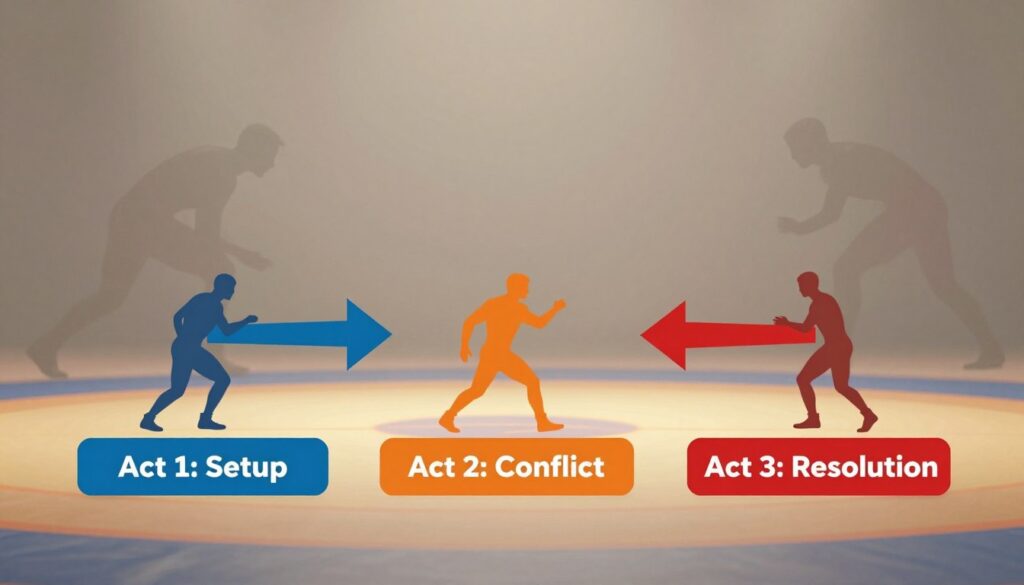
Understanding this framework is key to appreciating the psychology behind the action. It’s the difference between a simple fight and a story. A well-structured match has a rhythm and a purpose to every lock-up, reversal, and near-fall.
It’s what separates a forgettable bout from an unforgettable classic that we talk about years later.
The Three-Act Structure
A classic wrestling match follows a three-act structure. This narrative arc builds suspense and delivers a satisfying emotional payoff. We see this structure in countless classic matches.
It’s explored in discussions on wrestling as a narrative art form. It’s the skeleton upon which the drama is built.
The Feeling-Out Process
The first act, the feeling-out process, is the “Act I: The Setup.” It’s the beginning, where opponents test each other. It’s a chess match of early holds, collar-and-elbow tie-ups, and lock-ups.
This isn’t just stalling; it’s character and strategy. Is the powerhouse wrestler testing the speed of the technician? Is the underdog scouting for an opening? This phase establishes the physical and psychological dynamic.
It’s the calm before the storm, where the audience gets a first read on the competitors’ strategies and personalities.
The match then builds into the second act, where the conflict escalates. One competitor, often the antagonist, gains the upper hand, working over a specific body part to build heat and sympathy. The third act delivers the climax and resolution, the dramatic finish that resolves the story.
This progression from setup to struggle to resolution is the classic arc of a great wrestling match structure.
To visualize this narrative flow, let’s break down the three-act structure of a wrestling match:
| Act | Commonly Called | Primary Goal | Audience Emotion |
|---|---|---|---|
| Act I: The Setup | The Feeling-Out Process | Establish characters, test the waters, and establish the initial conflict. It’s the calm before the storm. | Anticipation, Curiosity |
| Act II: The Struggle | The Heat / The Build | One competitor gains control, works a body part, and builds sympathy for the underdog. This is where the story’s conflict is developed. | Sympathy, Tension, Anticipation |
| Act III: The Climax | The Finish / The Comeback | The resolution. The face makes a fiery comeback, or the heel gets their comeuppance. The story reaches its peak and resolution. | Catharsis, Elation, or Shock |
This structure isn’t a rigid cage, but a flexible framework. Great performers, like great storytellers, know how to play with these expectations. They might rush the feeling-out process or extend the second act to build unbearable tension.
But the core three-act match structure remains the reliable blueprint. It’s the classic story arc that we, as an audience, are instinctively drawn to. It makes the in-ring psychology resonate on a deeper, more emotional level.
Selling, Timing, and Emotion
The three-act structure is the blueprint for a wrestling match. But it’s the in-ring storytelling that brings it to life. This storytelling relies on selling, timing, and emotion. These elements turn a sequence of moves into a story that feels real.
The “magic” of a great match comes from the performance, not the script. It’s the pain, the pause, and the comeback that make it special. This is the true craft of in-ring storytelling.
The Art of Selling
Selling is the language of the ring. It shows pain, fatigue, and vulnerability. True selling makes the struggle real. If a wrestler’s leg is targeted but they run fine next, the story is broken.
Great selling is a full-body performance. It’s the favoring of a limb, the breathing, and the shaky attempts to get up. It’s not just the impact but the lasting effect. This creates a shared reality with the audience.
Timing and Pacing
Timing is the rhythm and grammar of the story. Pacing guides the audience’s emotional journey. It makes the match either chaotic or a symphony.
Good timing knows when to speed up and slow down. It’s the pause before a big move and the kick-out at the last second. This rhythm is the match’s heartbeat. Poor timing makes a match disjointed, while great pacing is the essence of in-ring storytelling.
This rhythm is tied to emotion. A babyface’s comeback is built. The crowd’s energy builds as the face finds a second wind. The timing of their rally is a masterclass in emotional release.
Emotion is the fuel. The fire in a babyface’s eyes and the sneer of a heel are not scripted. In-ring storytelling at its peak is a conversation of selling, timing, and emotion. When a wrestler sells their exhaustion and the timing of a comeback is perfect, the audience feels it. And that is the ultimate goal of every great performance.
Babyface vs. Heel Dynamics
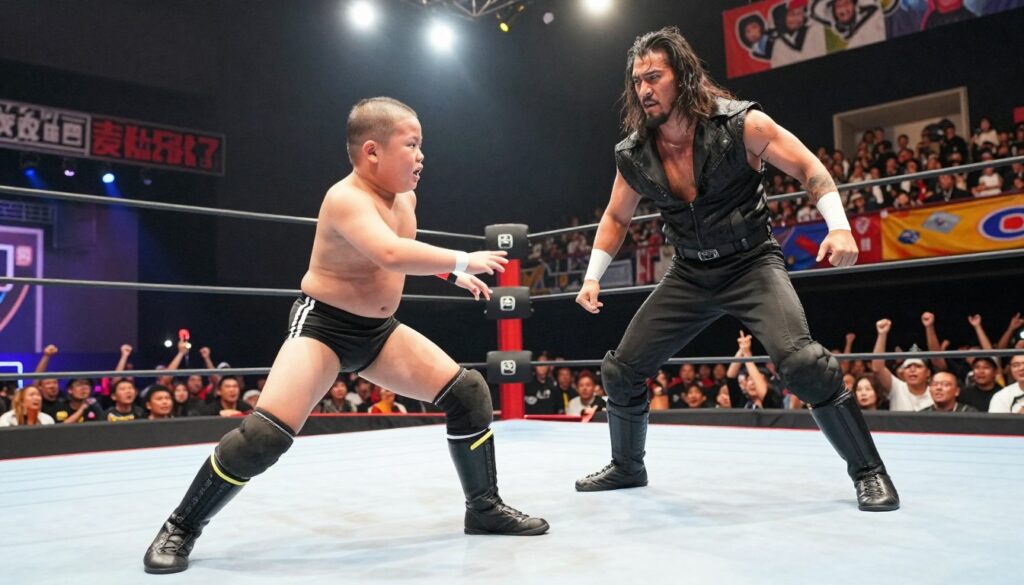
Professional wrestling is all about the battle between the babyface and the heel. It’s more than just good vs. evil. It’s what makes the crowd feel for the hero and hate the villain.
The Hero’s Journey: The Babyface’s Path
The babyface is like the crowd’s hero in the ring. They show heart and fight through tough times. It’s not about being unbeatable; it’s about never giving up.
The hero often starts off weak, taking a lot of hits from the heel. They make the crowd believe in their comeback. It’s like an underdog story, where the hero’s victory is a win of spirit.
The Heel’s Playbook
The heel is the clever villain who creates the conflict. Their wrestling psychology is about control and trickery. Heels use every trick in the book to win.
Heels control the match by targeting weaknesses and slowing it down. They use rest holds to frustrate the hero and the crowd. This makes the hero’s comeback even more exciting.
Heels also use psychological games to get under their opponent’s skin. They talk trash and break rules when no one’s looking. This makes the crowd want to see them punished.
Here’s how their strategies compare:
| Strategy | Babyface (The Hero) | Heel (The Antagonist) |
|---|---|---|
| Primary Goal | Overcome the odds and win with honor. | Win by any means necessary, break the rules. |
| Crowd Role | Elicit cheers and emotional investment. | Provoke anger and create a “love to hate” reaction. |
| Key Tactic | Resilience, hope, and a dramatic comeback. | Control, manipulation, and targeted, relentless offense. |
The magic of wrestling psychology is in this battle. The heel’s aggression makes the babyface’s comeback more meaningful. When the hero comes back, it’s a story of good vs. evil. This is the heart of wrestling psychology: a physical chess match where every move tells a piece of the story.
Crowd Control Techniques
In professional wrestling, we don’t just perform for the crowd; we perform with them. The most electrifying matches are shared, emotional journeys. We guide the crowd’s energy like a symphony, telling a story together. This is the heart of in-ring storytelling.
It’s not just about moves; it’s about controlling the emotional temperature of the arena.
Reading the Room
We listen as much as we perform. The crowd’s roar is a real-time conversation. A great wrestler is a master listener.
We don’t just hear the volume; we listen for the quality of the sound. Are the boos deep and genuine, or are they playful? Are the cheers for the underdog’s comeback, or for a specific move?
We read the room by its chants, silences, and gasps. This isn’t passive listening. It’s active collaboration. When the audience’s energy dips, we adapt. When it swells, we ride that wave.
Pacing is the invisible script of a great match. It’s the strategic ebb and flow of energy. You can’t go full-throttle for twenty minutes.
We use pacing to build in-ring storytelling that breathes. A slow start can build tension. A flurry of moves can jolt the crowd awake. Then, we pull back to let everyone catch their breath.
This rhythm is what makes explosive moments land. The goal is to create a rollercoaster the audience is thrilled to ride.
This delicate balance is what separates a sequence of moves from a memorable match. The following table illustrates how a wrestler might adjust their performance based on the crowd’s live feedback:
| Crowd Reaction | Wrestler’s Adjustment | Goal of the Adjustment |
|---|---|---|
| Loud, sustained cheers for a babyface | Extend the “hot tag” sequence, make the comeback more dramatic. | Amplify the emotional payoff and catharsis. |
| Audience chants for a specific, high-risk move | Tease the move, delay its execution, or have it countered to build suspense. | Maximize anticipation and dramatic tension. |
| Crowd becomes quiet or distracted | Introduce a high-impact spot or a sudden, dramatic plot twist (a surprise run-in, a weapon reveal). | Re-engage the audience and re-establish control of the narrative. |
| Mixed reactions (loud boos AND cheers) | Play to both sides; let the conflict in the crowd fuel the in-ring drama. | Deepen the story by highlighting the character conflict. |
The most powerful in-ring storytelling happens when we perform with the audience. We read their energy, adjust our pacing, and let their reactions shape the story. This real-time collaboration is the invisible art of the ring.
It’s not just about controlling the crowd, but about conducting a shared, unforgettable experience.
Case Studies of Classic Matches
Looking into wrestling’s most famous matches shows how great psychology turns physical fights into unforgettable tales. We learn a lot by seeing how legends create drama, suspense, and emotional ties through match structure. These classics prove that how a story is told in the ring is as important as who wins.
The best matches are lessons in psychology. Every move, reversal, and near-fall has a story purpose.
Anatomy of a Comeback Story
Let’s dive into a masterclass in match structure wrestling psychology: the epic fight between Shuji Kondo and Katsuhiko Nakajima. It was a battle of the veteran champion (Kondo) against the young challenger (Nakajima). The story was clear from the start: the strong, seasoned champion versus the determined, younger fighter.
The brilliance of the match structure was in its smart, focused psychology. Nakajima, the underdog, didn’t just try to overpower Kondo. He had a clever plan: he went after Kondo’s lariat arm, the key to his most powerful move.
This wasn’t just random fighting; it was a well-thought-out story. Nakajima didn’t just attack the arm; he carefully took away Kondo’s main weapon. When Kondo, feeling too confident, tried his powerful lariat near the ring post, his injured arm failed him. The match structure wrestling was perfect: a clear start, middle, and end that felt right.
The Perfect Heel Performance
This match also shows a perfect heel performance, but not in the usual, boo-worthy way. Kondo’s heel work was in his psychology, not just his actions. His overconfidence was his biggest mistake—a classic story flaw. He thought his power alone would win, but it was his downfall, making the match structure wrestling a classic tale of strategy versus arrogance.
The heel in this story isn’t just a “bad guy.” He’s a character whose overconfidence controls the match and his defeat.
| Classic Match | Psychological Element | Key Psychological Moment | Match Structure Principle |
|---|---|---|---|
| Kondo vs. Nakajima | Strategic Targeting | Nakajima’s systematic attack on Kondo’s lariat arm | Logical cause-and-effect psychology |
| Classic Rivalry A | Emotional Grudge | Building heat through personal history and betrayal | Long-term storytelling |
| Technical Showcase | Technical Mastery as Psychology | Using chain wrestling to tell a story of technical superiority | Psychology through technical excellence |
| David vs. Goliath | Overcoming the Odds | The “hope spot” where the underdog almost wins | Building and releasing dramatic tension |
What we learn from these examples is that psychology in wrestling isn’t just about pleasing the crowd. It’s about making the story believable. When we analyze these matches, we see that the best wrestlers know that match structure wrestling psychology is about making us believe in the struggle. It’s why we remember these matches years later—not for the moves, but for the story they told.
The comeback, the underdog’s strategic win, and the heel’s arrogance leading to their defeat—these are timeless stories. In the ring, they’re told through holds, strikes, and the beautiful, brutal psychology of professional wrestling.
Why Psychology Separates Good from Great
Great wrestling psychology turns moves into a story. It’s the magic that makes a match unforgettable. This skill makes a wrestler stand out as a legendary storyteller.
This skill connects the audience deeply. A well-timed kick-out can be more exciting than the final count. True wrestling psychology is about emotions, tension, and storytelling. It’s about making the audience feel something.
For a deeper look, check out the psychology of winning and losing. It shows how it affects a performer’s mindset.
Mastering this craft means knowing a match is a conversation with the crowd. It’s not just about moves, but when to use them. The pause before the final move and selling an injury make a match special. This turns a contest into a shared emotional journey.